The compatibility score is now based on your whole profile
The percentage on a profile came from the prompts alone. It now checks dealbreakers, then weighs your whole profile.

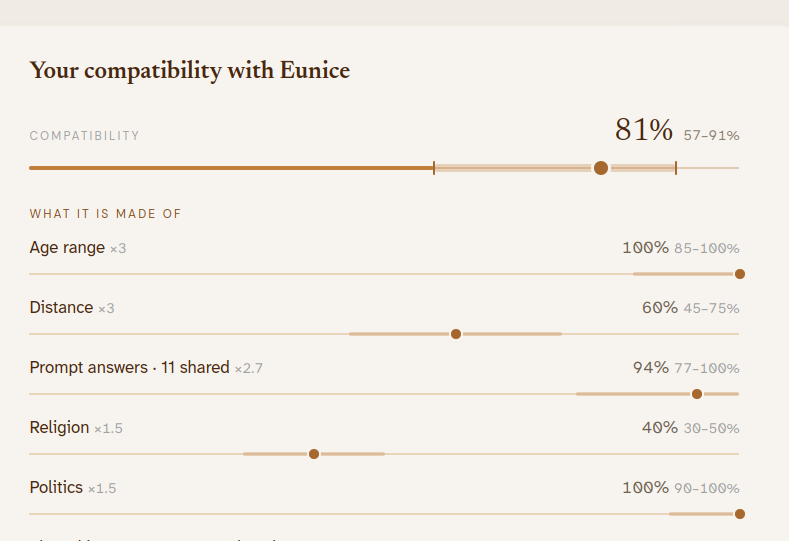
The percentage on each profile used to come only from the compatibility prompts you both answered. The problem was that two people could score 80% on the prompts while one wanted children and the other did not, or while one lived in London and the other in San Francisco with a 100-mile limit.
The score now reads your whole profile, checks the dealbreakers first, and only then weighs everything else. The full set of rules is on a new page, How the compatibility score works, and as usual its implementation is open-source. Please check out the full page!
Small correction about my last post
In the post about the prompts I wrote that "current evidence says matching algorithms do not predict accurately whether a relationship will work". Deciding whether to build this score forced me to actually read the studies behind that sentence, and I no longer think it holds.
The evidence is thin, not negative. The study most people cite, the one where a machine-learning model could not predict who would like whom, measured attraction after a four-minute speed date between 19-year-old students at one university, with a questionnaire that skipped children, location, religion, diet and life plans. Four minutes measures first attraction, nothing near whether a relationship lasts. I wrote more about it in the evidence section of the new page.
So here is what I now take from the evidence, and what the score is built to do. A profile predicts a lack of compatibility accurately when there is a dealbreaker. It suggests promising candidates through preferences, values and shared ground, but without the precision to single out the one compatible person among them. And most of what makes two people compatible is only revealed when they interact.
If you like to see things in numbers, think of it this way. Imagine you are a monogamous vegan woman looking for a like-minded husband around the same age. If you were to randomly pick people in the whole population (like knocking on doors one by one), it'd be extremely inefficient; you may find a compatible partner after seeing a million people. If instead an algorithm could provide you with a pool of monogamous vegan single men in your age range, you may find a compatible partner after seeing a thousand of them. So this algorithm, simply encoding a few dealbreakers, is useful in the sense that it's 1,000 times more efficient at finding you matches, moving your odds from 1:1M to 1:1,000. It's however unlikely that an algorithm gets you past the 1:1,000 odds (i.e., finding you that one compatible person after a few trials), which is, I think, what authors behind the research mostly mean by "matching algorithms don't work".
The sentence I should have written last time is: nobody has shown that a matching algorithm can pick your partner, and nobody has shown that it cannot help you find the people worth talking to.
Alerts can now use the score too
The filters now have a Compatibility entry: at least 50%, 60%, up to 90%. If you notice that the people in your search alert are too far from what you're looking for, even after clearing your dealbreakers, I'd recommend you add the compatibility filter so you only hear about the ones above the bar you set. I'd recommend setting the bar to 70% or 80% because, as discussed above, compatibility scores aren't so good at distinguishing a good match from a perfect one.
What I would like from you
This is the first release of the score. The rules and weights are hand-picked, not trained on outcomes, and I expect to change them.
Open the breakdown on a few profiles and tell me where it is wrong. A row that seems off, a weight that feels too heavy or too light, a number that does not match your experience with someone you have actually talked to.
Send evidence. A study, a dataset or your own experience showing that profiles and algorithms predict compatibility better than I now think, or worse. Just message me, or use the contact form or GitHub issues.