The compatibility questions got a rewrite
Most of our question bank was either too context-dependent or not divisive enough. We read 3,103 candidates from existing apps and kept 370. Here's how, and why.

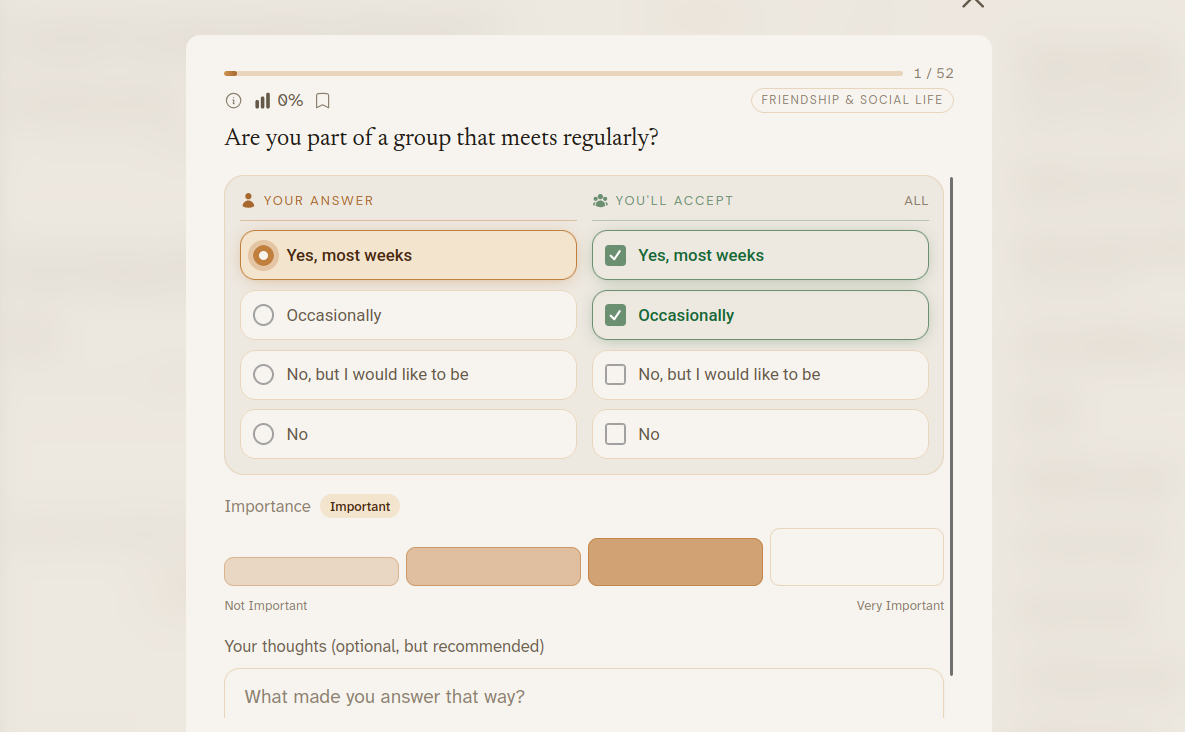
Compass shows you a compatibility percentage next to every profile. That number comes from the questions you answer on the compatibility page — and until this month, most of those questions were either too context-dependent or not divisive enough.
I've now rebuilt the set, trying to keep or rewrite as many existing questions as possible so you haven't wasted time answering them until now.
How the score works
Every question is answered along three axes:
You pick one answer for yourself. "This is me."
You pick every answer you'd accept in the other person. Any subset — one, three, all of them.
You mark how much it matters to you, from Not Important to Very Important.
The score is then asymmetric. My score with you counts my importance weights on the questions where your answer falls inside my accepted set. And vice versa. The two get combined, and the result is pulled toward 50% until you have roughly 100 questions in common — so a 94% built on eight shared answers doesn't exist, by design. It shows as low confidence and sits near the middle.
Two consequences fall out of that:
A question only ever scores when both people answered it. A question nobody answers is dead weight taking up space in your list.
A question only tells us anything if people's accepted sets differ. If nearly everyone accepts every option, it adds the same points to every pair — pure noise. "Do you like to cuddle?" was the second most-answered question in the old set and close to useless.
What a matching score can honestly claim
Unfortunately, current evidence says matching algorithms do not predict accurately whether a relationship will work. So the percentage next to a profile is not a prediction that you'll click. What a question set can do is still worth a lot though:
Screening out structurally impossible pairings. Kids, monogamy, location, religion. Dealbreakers weigh more than dealmakers in real mate choice, and removing hard mismatches is the highest-value thing this does. You can filter by "incompatible" to surface those questions.
Producing perceived similarity, which predicts attraction and satisfaction more reliably than actual similarity does.
Giving you something worth talking about. Escalating mutual disclosure is the mechanism that generates closeness.
What makes a question good
The full guidelines are public in the repo, with the research behind each one. The short version:
Ask about values, plans and behaviour — not personality. Similarity in values and life plans predicts stability. Similarity in personality traits largely doesn't. So "Do you want to raise children?" stays and "Are you an introvert or an extrovert?" goes.
Ask what people can report accurately. "Are you a good listener?" has one answer everyone gives — not because people lie, but because nobody sees it in themselves. That trait is real and important and simply not measurable this way. So it becomes: "A partner vents about work. What do you actually do first?"
Every option has to be one a real person would pick.
No "it depends" escape hatches. If your honest answer changes by the week, two identical people land on different options and lose points to each other. The fix isn't adding an "it depends" button — it's narrowing the question until one answer is clearly true. "How do you handle stress?" becomes "In a stressful week, what happens to your contact with a partner?"
Every question must add something the others don't. The score sums your importance weights, so two questions measuring the same thing count it twice. If you mark both Very Important, you've silently given one topic double the weight you thought you gave it.
What I did
The pool was 3,103 candidates after merging duplicates: 2,620 OkCupid items, the 220 already live here, and more from other dating apps. 370 were selected, 67 of them marked as core.
The first 50 questions do nearly all the work. Because the score is pulled toward 50% until you've answered a lot, and because almost nobody reaches the end of a 300-question set, the real job is a core 50 that must be excellent and a tail that must merely be harmless.
More features
The questions now come in a deliberate order. Aron's closeness procedure — the "36 questions" one — works because disclosure escalates. So the first questions you're served are low-stakes and broad, and the vulnerable ones come later, once you have something invested. Films and sleep schedules first; addiction history and what you do when you're angry, last.
Every question now has a category tag — Kids & family, Money, Politics, Values & worldview, and eleven others — and you can filter the list by it. If you want to answer everything about money in one sitting, you can.
What I'd like from you
Answer the core set if you haven't. They help people filter for dealbreakers and give discussion ideas.
Tell me which questions are bad. I have opinions about which of the live questions are weak; I don't have data yet. Some of them will turn out to be questions where 90% of people pick the same option, or where everyone accepts every answer. Those need to be retired, and the fastest way to find them is you telling me one grated. If a question felt unanswerable, or had no option that fit you, or made you roll your eyes — contact me.
Write one. There's a submit your own button at the top of the compatibility page. The guidelines above are the bar I'd hold it to, and the most useful thing you can send is a question in a domain the old banks had not much on: friendship, work, money, ordinary daily life.